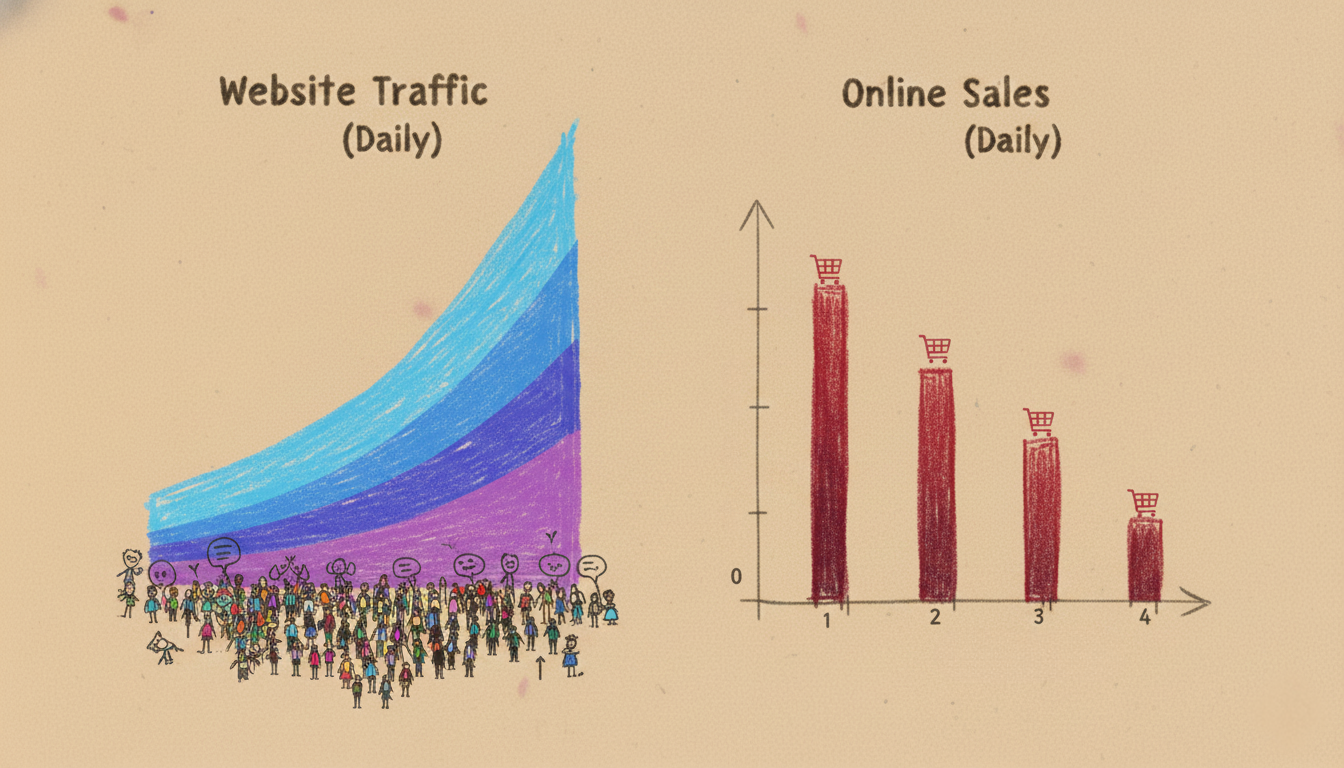
Your traffic numbers look fine. People are finding the site, clicking through, spending time on your pages. But the sales aren't following.
The default response is to start optimising: rewrite the headline, change the button colour, add a testimonial. This is where most businesses go wrong. They jump straight into conversion rate optimization before they have any idea what the actual problem is.
The result is a page full of changes that may or may not have addressed the real issue, and no way to know which ones did anything.
Diagnosing the problem first fixes that. This article walks through how to do it properly.
First: confirm it is actually a conversion problem
Before touching anything on your page, check whether the traffic coming in is the right traffic.
A conversion rate problem and a traffic quality problem look identical in the numbers. Both show up as high visits and low sales. But they have completely different fixes.
Pull your traffic breakdown by source. Look at bounce rate and time on page per channel. If people arriving from a specific ad campaign or keyword are leaving in under 10 seconds, the issue is likely that those visitors were never going to convert regardless of what the page said. They were not your buyer.
If your traffic quality looks solid across sources and conversions are still low, then yes: this is a conversion problem, and the page is where to look.
The 4 places conversions actually break
Most people focus entirely on the product page or landing page when conversion rates are low. That is usually too narrow.
Conversions can break in four distinct places:
1. The ad or search result
If the ad promises one thing and the page delivers another, visitors arrive with the wrong expectation. This mismatch is one of the most common and most overlooked causes of low conversion rates.
2. The landing or product page
This is where most attention goes, and sometimes it is the right place. Friction, confusion, missing information, weak copy, unclear pricing: all of these can stop a willing buyer.
3. The checkout or form
Unexpected shipping costs, too many steps, limited payment options, poor mobile experience: these are checkout problems, and they show up clearly in your funnel data. If your product page metrics look fine but checkout completion is low, that is where to focus.
4. The offer itself
Wrong price point, wrong framing, wrong timing. Some conversion problems have nothing to do with the page. The offer is simply not landing for the audience seeing it. No amount of conversion rate optimization will fix that.
Identifying which of these four is the actual problem is the whole point of diagnosis.
What your analytics can and cannot tell you
Analytics tools are good at showing you where people drop off. They are not good at telling you why.
You can see that 80% of visitors leave the product page without clicking add to cart. You can see that the checkout completion rate is low. You can see that a particular traffic source converts at a third of the rate of another. These are useful signals. They point you toward the problem area.
What they cannot tell you is what was going through someone's mind when they left. What question went unanswered. What concern tipped them toward closing the tab rather than continuing.
This is the gap that most conversion rate optimization work never closes. Businesses spend months running A/B tests on button colours and headline variations when the real issue is something that never shows up in analytics at all: a trust gap, a missing piece of information, a pricing concern that nobody thought to address.
How to find the real reason people are not converting
The most direct way to find out why people are not buying is to ask them. Not your team, not your agency, not a focus group of friends. The people who visited and did not convert.
Here are four ways to do it:
Abandoned cart emails with a single question
If someone added to cart and did not complete the purchase, send a short email. Not a discount. One question: "What stopped you from completing your order?" The replies will be more useful than most analytics dashboards.
Exit intent surveys
A single question triggered when someone moves to leave. Keep it to one question only. "What stopped you from [desired action] today?" gives you direct, unprompted answers from people at the exact moment they decided not to convert.
Post-purchase surveys
Ask buyers what almost stopped them. This sounds counterintuitive but it is one of the most reliable methods. People who did buy can still tell you what gave them pause, and those are exactly the barriers that are probably stopping others.
Direct interviews with your ICP
Five to seven conversations with people who match your ideal customer profile is enough to start seeing patterns. These do not need to be long. Thirty minutes per person. The goal is to hear how they describe their hesitation in their own words, because that language will tell you more than any heatmap.
When you are asking questions, avoid leading them.
"Was the shipping cost a problem?" is a leading question. "What information were you looking for that you could not find?" is not.
What patterns to look for
Once you have responses coming in, look for what multiple people mention without being prompted.
If three out of twenty people mention something, note it. If eight out of twenty mention the same thing, that is your problem. The threshold to act on is roughly 40 to 50% of respondents pointing at the same issue.
The most common patterns that come up:
- Trust gaps: people did not feel confident the brand was legitimate or that the product would work as described
- Unclear value: visitors could not quickly understand what the product does or who it is for
- Pricing anxiety: the price was present but the justification for it was not
- Missing information: a specific question went unanswered and they were not going to buy without the answer
Any of these will suppress your conversion rate regardless of how well-designed the page is. They are not visible in your analytics. They only appear when you ask.
The fix comes after the diagnosis
Once you know what is actually causing the drop-off, the fix is usually straightforward. If eight people said they could not find the return policy, put the return policy somewhere visible. If six people said the price felt high without explanation, add the context that justifies it.
This is how you increase conversion rate with some confidence that the change will do something. Not by guessing which tactic to try next, but by removing a barrier that real buyers told you was stopping them.
Conversion rate optimization, done properly, is not a list of best practices to work through. It is a process of finding out what is in the way and removing it.
How Brightverse helps
Finding the right people to ask, writing questions that do not lead the answer, and spotting the patterns across responses takes time most teams do not have.
Brightverse does this for you. We source real buyers from your ICP, run the sessions, and deliver the findings with specific recommendations on what to fix.
If your traffic is healthy and your conversions are not, get in touch and we can look at what is going on.
Get in touch